Emmett Bernsohn
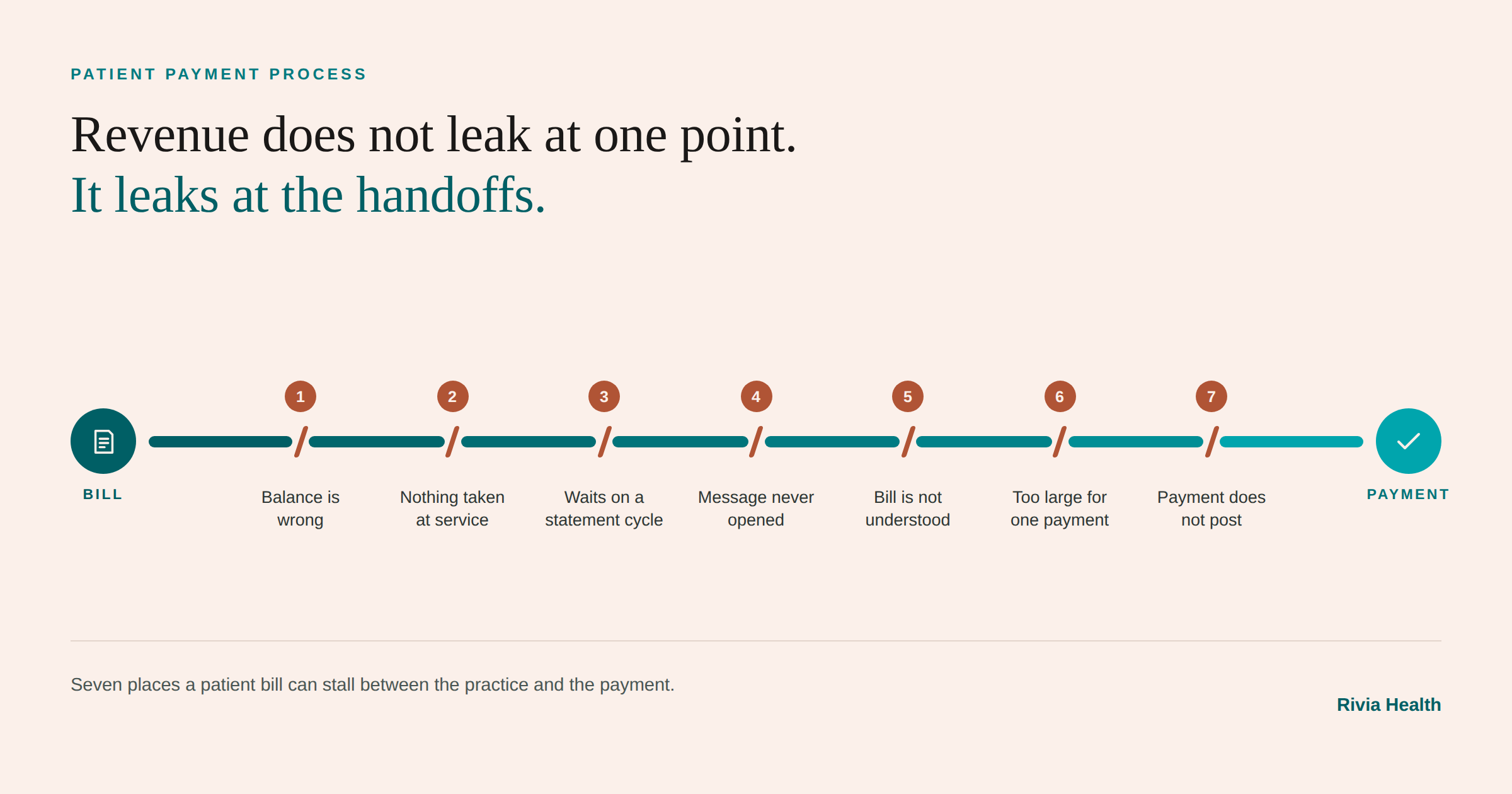
Many practices review patient revenue as a single number: what percentage of patient responsibility eventually came in. That number matters, but it does not tell you where revenue is getting delayed, where staff time is being consumed, or why balances keep aging. Understanding the patient payment workflow journey is key to identifying these issues.
The patient payment process is not one event. It is a chain of handoffs, and a balance can stall at any point without anyone in the organization owning the stall.
For specialty practices and ambulatory physician groups, the better question is not simply how much patient responsibility was collected. It is where the process creates friction, how much manual work each step requires, and which steps can be removed entirely.
Here are seven common breakpoints, what each one costs, and why the most effective patient payment strategies focus on shortening the process rather than adding more follow-up.
Elapsed time is the cost driver, not effort
Every day between the moment a balance becomes the patient’s responsibility and the moment it is paid creates another opportunity for that balance to age. More days can mean more statements, more calls, more staff follow-up, and less patient recall.
That makes elapsed time an operating metric, not just an accounts receivable metric.
The longer a balance sits, the more likely your team will need to touch it. The goal should be to move from balance creation to payment with as few manual steps as possible.
The seven breakpoints
1. The balance is wrong before anyone sends it
Coverage was not verified, the plan changed, or the patient’s responsibility was estimated from incomplete or outdated information. The bill goes out anyway, and the practice creates a downstream problem that could have been prevented upstream.
This is one reason automation across administrative healthcare transactions matters. The 2025 CAQH Index estimates a $21 billion annual savings opportunity from fully automating healthcare administrative transactions that remain manual or partially manual, including eligibility-related transactions. That figure is an estimate of administrative savings across the industry, not a measure of billing accuracy, but it illustrates the cost of leaving repetitive work in the process.
For the patient payment workflow, the lesson is straightforward: better data at the start reduces avoidable friction later.
2. Nothing is captured while the patient is still in the building
The front desk is one of the earliest opportunities to address patient responsibility, but time-of-service collection has fallen significantly. MGMA reports that time-of-service copay collection fell from about 90% in 2019 to 56% in 2022, while time-of-service collection of patient-due balances increased from about 15% to 39% over the same period.
Every balance that remains unresolved after the visit moves into a more expensive part of the revenue cycle. The practice now has to reach the patient after they have left, and the patient has to make time to deal with a bill at home.
The opportunity is not simply to collect more at check-in. It is to make patient responsibility easier to address throughout the journey, before a balance becomes aged A/R.
3. The balance waits on a cycle instead of an event
The claim adjudicates, the patient’s responsibility is known, and then the balance sits until the next statement run.
Nothing is necessarily broken. The workflow is simply waiting on a batch process instead of responding to a real-time event.
That delay matters because time creates more work. When outreach begins as soon as a balance is ready, the practice can engage the patient while the visit is still recent. When outreach waits for the next statement cycle, the process has already added another avoidable handoff.
For revenue cycle leaders, the practical question is simple: does your patient payment workflow respond when a balance exists, or does it wait for the next batch?
4. The message arrives and no one opens it
A paper statement competes with everything else in the mailbox. A generic email competes with everything else in the inbox. Sending a message is not the same as getting a patient to act on it.
Groups often respond by sending more notices through the same channel. That adds volume without necessarily removing the underlying friction.
A better approach is to use the channels patients actually engage with and automate the timing and cadence around the balance. Rivia Health, for example, uses patient engagement workflows across text and email and can continue outreach beyond the traditional 30-60-90-day cadence.
5. The patient reads the bill and cannot tell what it is
This is an important source of payment friction, but it should not be confused with an affordability problem.
KFF found that among adults with health care debt, 67% said they had not paid or only partially paid a medical bill because they did not have enough money. At the same time, 68% said they had not paid a bill in full because they expected their health insurance to pay it, and 44% said they did not pay because they were not sure the bill was accurate.
The takeaway for practices is that unpaid balances can have multiple causes. Some patients cannot afford the balance. Others are waiting for insurance or questioning what they owe. Both situations create work for billing teams, but they require different responses.
When patients cannot understand a balance, the result is often a billing call or a delayed payment. Clear bill details, EOB information, and immediate access to answers can remove that friction without requiring staff to explain the same questions over and over.
6. The patient is willing and the balance is too large for one payment
A large balance does not always mean an unwilling patient. It can mean the payment option does not match the patient’s ability to pay.
KFF found that 67% of adults with health care debt reported that they had not paid or only partially paid a medical bill because they did not have enough money. For practices, that makes payment flexibility an important part of the revenue strategy, not simply a patient amenity.
A payment plan should not require a phone call or create another manual queue for staff. The easier it is for a patient to choose an appropriate payment option, the less likely a willing balance is to become aged A/R.
7. The payment arrives and does not land cleanly
The patient pays. Then someone still has to reconcile the payment, match it to the right balance, or confirm that it posted correctly.
That is a different kind of payment friction: the patient has completed their part, but the workflow has not.
Real-time posting at the date-of-service level can remove that handoff. Rivia Health’s platform integrates with the EHR, receives balance updates, and posts payments back in real time, reducing the need for manual reconciliation and double data entry.
Specialty practices break in more places at once
Specialty practices have different patient journeys, different clinical workflows, and different patterns of patient responsibility. An orthopedic surgical episode looks different from a women’s health episode, and neither looks like a routine primary care visit.
The underlying payment problem is the same: the more handoffs between balance creation and payment, the more opportunities there are for a balance to stall.
That is particularly important for ambulatory groups with multiple locations, specialties, or billing workflows. A patient may have several balances, each with a different date of service and payment timeline. If the patient experience is fragmented across those balances, the billing team inherits the complexity.
The goal is not to make every specialty operate identically. It is to automate the repetitive work while giving patients a clear, consistent path to understanding and resolving what they owe.
The fix is subtraction
When patient revenue underperforms, the instinct is often to add: another statement, another call campaign, another staff member on follow-up, eventually an outside agency.
But adding touches also adds cost.
The better approach is to shorten the chain. Remove the wait between adjudication and outreach. Remove the login. Remove the phone call a patient has to make just to understand the bill. Remove the manual reconciliation step after payment.
Each removed step creates fewer places for a balance to stall and less work for the billing team.
Collections should be the last resort, not the operating model. Collection agencies typically work on a contingency basis, and Rivia Health’s current customer-facing materials cite fees of roughly 30% to 50% of recovered amounts. That means every account sent outside the practice can carry a high cost to collect in addition to the patient relationship cost.
The strategic question is not how aggressively to pursue aged balances. It is how much of that aging can be prevented in the first place.
What to measure between the bill and the payment
Most revenue cycle dashboards emphasize payer performance and treat patient responsibility as a residual. That makes it harder to see where the patient payment workflow itself is creating delay and staff work.
Four measures can help executives find the operational bottleneck:
- Time-of-service capture rate. What percentage of expected patient responsibility is captured before the patient leaves? This shows how much payment activity is being pushed downstream.
- Days from balance ready to first patient payment. Measure the elapsed time specific to patient responsibility rather than relying only on total A/R days.
- Inbound billing call volume per 1,000 statements. A useful operational signal for how often patients need help understanding or resolving a balance.
- Percentage of patient balances that reach 90 days. A clear indicator of how much patient revenue is aging instead of resolving earlier in the workflow.
These metrics shift the conversation from outcome alone to cause. Instead of asking only how much patient revenue was collected, leaders can see where time and staff effort are accumulating.
What a shorter chain looks like
The technology to address these breakpoints already exists. The useful question when evaluating a patient payment platform is not how many features it has. It is which steps it actually removes.
Does outreach start on an event or a cycle?
If outreach begins when a balance is ready rather than waiting for the next statement run, the practice removes an avoidable delay.
Can the patient pay without creating an account?
Every login, password, or app download is another point where a willing patient can stop. Rivia Health’s digital payment experience does not require a portal account, password, or app download.
Does the bill explain itself?
Clear balance information, dates of service, and EOB details can help patients understand what they owe and why. More notices do not solve an information problem.
Can the patient set up a plan without calling your staff?
Payment flexibility works better when patients can self-enroll rather than creating another task for the billing team. Rivia Health supports automated payment plans as part of the patient payment workflow.
Where does the payment land?
Payment capture is not complete when the card is charged. The payment also needs to flow back into the practice’s system accurately and quickly. Rivia Health supports real-time posting at the date-of-service level.
These are the questions worth asking of any patient payment technology, including Rivia Health. A platform should make the workflow shorter, reduce manual touches, and give the billing team better visibility into what is happening across the patient payment journey.
Rivia Health customer results illustrate what that can look like in practice. Current customer results include a 38%+ reduction in bad debt across ambulatory specialties, 389 hours saved per month for TrustCare Health, 69% fewer bills sent to collections among active athenahealth customers, and an average 15-day time to payment compared with a 60-day industry benchmark cited by Rivia Health.
The point is not a smaller billing team. It is a billing team that spends less time chasing patient balances, reconciling payments, and answering repetitive questions, and more time on the work that requires their expertise.
The takeaway
Patient revenue does not leak at one point. It leaks at the handoffs.
The longer the path from balance creation to payment, the more opportunities there are for delay, confusion, manual work, and aging A/R.
Before approving another statement vendor, another outreach campaign, or another FTE for patient follow-up, ask a different question: Which steps does this investment eliminate, and which ones does it simply add staff to manage?
The practices that improve patient revenue are not necessarily the ones pushing hardest at the end of the process. They are the ones that make the process easier to complete in the first place.
See what Rivia Health can recover
Rivia Health automates patient payment workflows from balance creation through final payment, with patient engagement, portal-free digital payments, payment plans, billing support, and real-time payment posting built into the workflow.
See how Rivia Health can help your practice capture more patient revenue, reduce aging A/R, and give your billing team time back.
Sources
-
2025 Employer Health Benefits Survey, KFF, October 2025.
-
Health Care Debt in the U.S., KFF.
-
Patient balance collection: What’s moving the numbers and how to get ahead, MGMA, October 2025.
-
2025 CAQH Index, CAQH / DataSpring, February 2026.
-
Consumer Reporting (Regulation V), CFPB. The CFPB’s medical debt credit-reporting rule was vacated by a federal court on July 11, 2025.